The Ancient Travels of Two Bennett Clans
Michael Cooley, BA, MA • 27 June 2023
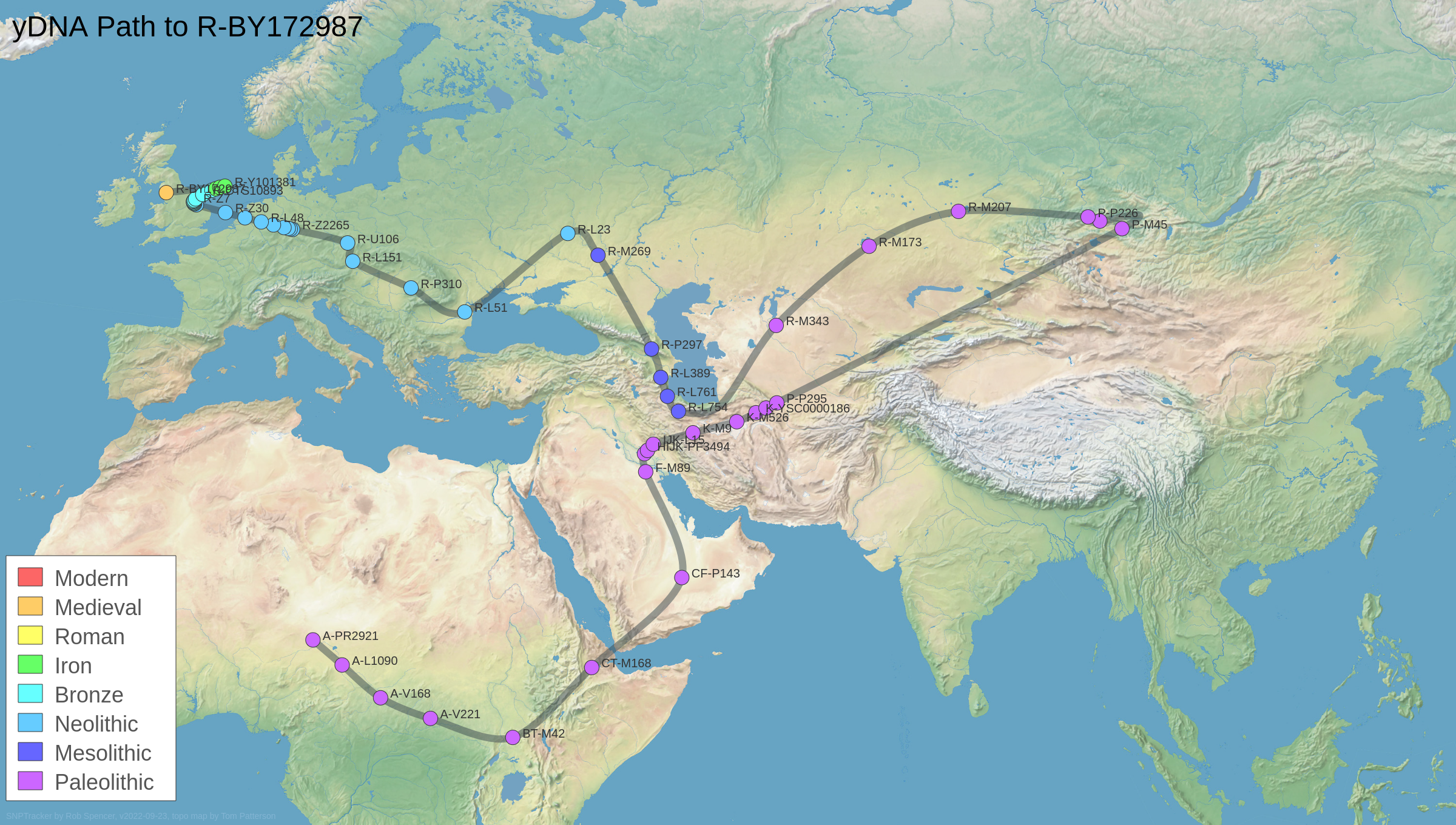
The maps below compare the journeys out of Africa for two different Bennett families later of early colonial Virginia, the Blackwater Bennetts and those descended from "Dr" John Bennett. They were once thought to have been related, but we see below that they diverged after the marker L151 was introduced into the lineage in Eastern Europe. In other words, there was a man born about 5,000 years ago, possibly somewhere in modern day Austria, born with that mutation (completely harmless, by the way). Some generations later, a descendant in one lineage was born with a marker called U106. His descendants traveled through modern day Germany and the Low Countries into England, north of London if we are to believe the map. These are the Blackwater Bennetts. According the map, they ended up in the area of Liverpool. (All such genetic maps are in their infancy. Several million testers are needed before it reaches a degree of maturity.)
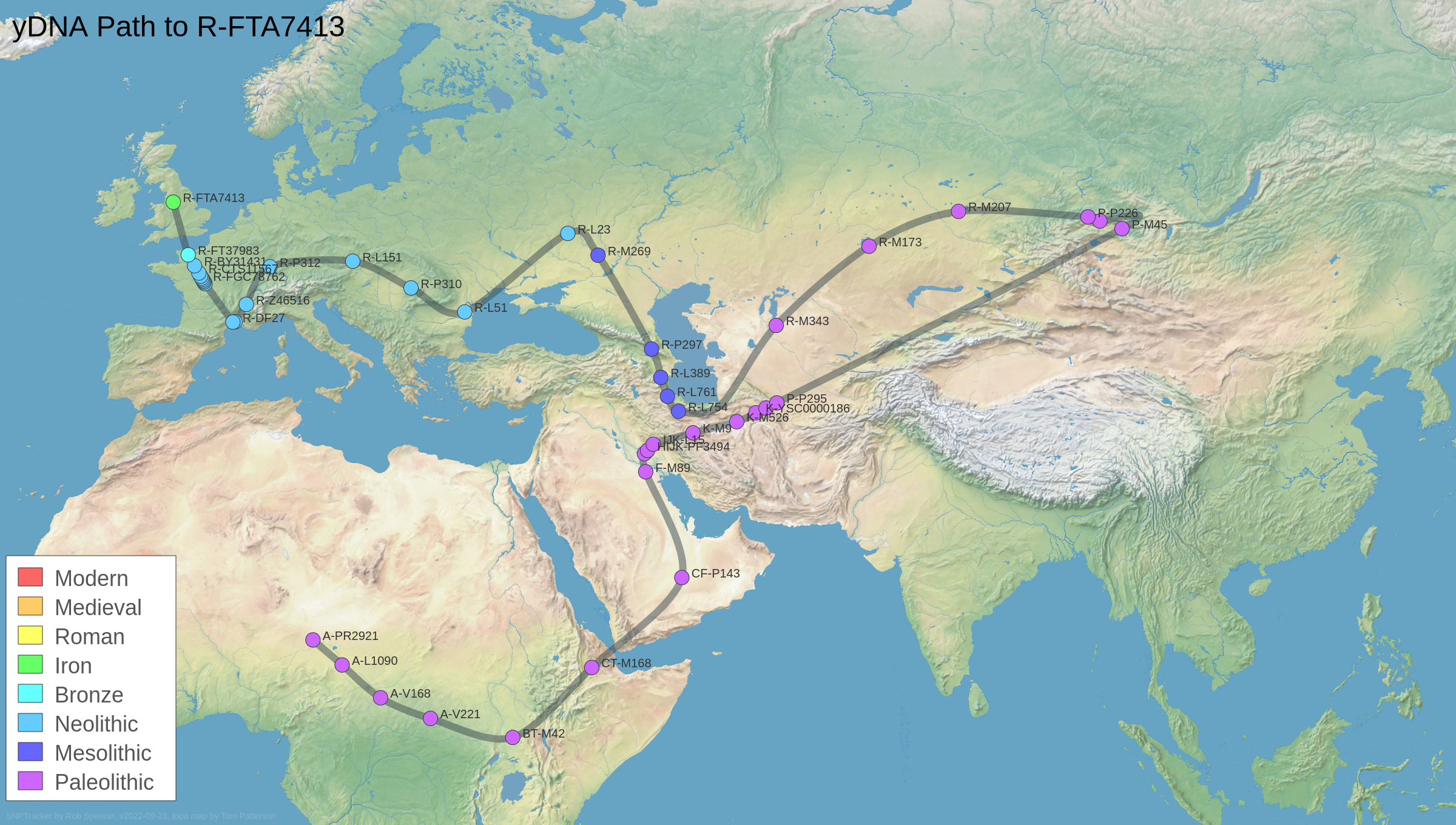
The second map is for the "Dr" John Bennett testers. They are believed to have settled in the same general area of England as the Blackwater Bennetts, but the route they took is quite different. A man was born with the marker P312 perhaps just east of modern day France. His descendants traveled to southern France and then north up western France and landed in the south of England.
The first thing to remember is that the Y chromosome passes 100% through every male lineage and that any newly emerged SNP markers accumulate in the various lineages. (What was, is.) Thus, every man holds an archive of the travels of his male lineage in each of the trillions of cells in his body. Naturally, the place names aren't recorded. It's up to us to figure it out.
The Dr John Bennetts have a formidable challenge. Their terminal haplogroup — the one that genetically defines the group — is FTA7413. But that haplogroup alone presently has 27 SNP markers. If we consider that each marker comes into a lineage about once every 100 years (it can vary a great deal) then the FTA7413 haplogroup could cover a period of about 2700 years. All it takes is one person who has all but one of the markers to begin breaking through that genetic wall.