
Click image to enlarge
Wiveliscombe Bennetts in London
My search for a proven, living representative of the Wiveliscombe, Somerset, England Bennetts continues. It's my usual "go to" once all emails are answered and new Y-DNA tests are processed and reported. The purpose of this endeavor is to find such a man then entice him to test his Y chromosome. Some believe that "Doctor" John Bennett who died around 1668 in Virginia is of this family. The Y-DNA signature for him has been determined through the testing of several male-lineage descendants and we now know they are of Y chromosomal haplogroup R-FTA7413. Now that that's established, any male Bennett can prove his descent from John through a simple test.1
But contradictory information exists that casts doubt that John was of the Wiveliscombe Bennetts. Another group of Bennetts claiming descent from the same family, present in Virginia since 1618, has also Y-DNA tested. They're referred to as the Blackwater Bennetts and are of haplogroup R-BY172987. These two Bennett families are separated by thousands of years through their respective paternal lineages. It's impossible they were patrilineally related. One of the two families might have been of the Wiveliscombe family, but certainly not both.
The solution is to find a fully-proved lineage going back to Robert Bennett (died 1603), the progenitor of the Wiveliscombe Bennetts. Apart from the possibility of one of the two Y-DNA lineages I've described, no such lineage is known to exist. If this is going to work it's time to start fishing, if in near darkness, and take it slow, methodically, and with the expectation that new pathways will begin to open.
Anyone doing this research knows that Edward Bennett (1577) of Wiveliscombe was a wealthy merchant and the founder of a Virginia plantation in 1622. He sent his brother Robert with the first settlers on the Seaflower but Robert died the following year. Edward then dispatched another brother, Richard, but he died in 1626. Finally, in 1628, Edward himself arrived with two nephews in tow, Richard and Robert, cousins to one another.2 Within the year, Richard took over the management of his uncle's estate and Edward returned to his family in London. In time, Richard became wealthy in his own right and was eventually appointed the Parliamentarian Governor of Virginia. But he left one son, Richard, but died as a young man in England about four months prior to the birth of his son, yet another Richard. Unfortunately for future genetic genealogists, he had no children. The Y chromosome along this branch of the family died with him.
It seems that the lack of surviving male progeny was a feature of this family, as we can easily observe by looking at the descendants of their progenitor Robert Bennett (died 1603), a successful tanner in Wiveliscombe and Edward's father. The males known not to have continued the lineage are shown in bold.
Of course, there's much to do to fully firm up the above tree. For example, John Dorman writes that Edward "was still living in 1638 when his son Jasper was buried" but offers no source for the burial.3 On the other hand, Archibald F Bennett states,4
Jasper Bennett was listed as servant of Lt. Col. Nathaniel Pope of Virginia, who was associated in mercantile transactions with London. (Hoppin: Washington and Allied Families, Vol. I, p. 283.)
Jasper Bennett was buried at Sutton, Surrey, 11 Apr., 1690. (Sutton Parish Register, p. 20)
But there may be additional threads to pull on. There were other Bennetts in Wiveliscombe and nearby Milverton who were likely of this family. However, most of the following is speculative to varying degrees. There are several things to consider as we move forward.
Good genealogy depends on good research, and that research requires time. It's not a snap decision. If the evidence isn't conclusive, then there must be one or more verifiable factors that make the premise at least reasonable. Still, in the end, it's quite okay that the premise ends up being discarded. This isn't about ego.
There was a Thomas Bennett residing in Wiveliscombe who has not yet been identified as a descendant of the patriarch Robert Bennett (at top). He married Agnes Beard in Wiveliscombe in 1624. At this point, however, I'd consider it relatively safe to assume he was of the family despite his unclear parentage. But it's clear he was not a son of Thomas Bennett (1570), a son Robert Bennett, as is so often stated. The elder Thomas had a son Thomas baptized in 1603 and died in 1608. This is clear as both records state "Thomas son of Thomas." And I should point out that John Boddie Bennett stated as much in his excellent 1938 book, Seventeenth Century Isle of Wight County, Virginia.8 No matter how researchers try to flavor their arguments, Agnes's husband was not baptized to the senior Thomas Bennett in 1603. I discuss this a bit more below.
Much has been written about the children of Thomas and Agnes. But a Thomas had several, like clockwork, before the couple's marriage in 1623. Some genealogists in the 1930s attributed them to Thomas Sr (1570) but it's now well-accepted that he died in Wiveliscombe in 1616. It is possible that this was yet another Thomas, and we must avoid conflation. But there were not a whole lot of Thomases to go around in the small village of Wiveliscombe. It makes sense that all these children belonged to the same father and that he married twice.
All baptisms were recorded at St Andrews Church in Wiveliscombe and are now preserved at the Somerset Archive in Taunton, about 15 miles away. It's unfortunate, but St Andrew's typically didn't record the mother on baptisms in the early years. Here's a list of Thomas's sons and the years of their baptisms.
Marvell Bennett, 1618
Thomas Bennett, 1620
Lawrence Bennett, 1622
John Bennett, 1624
Richard Bennett, 1625
Philip Bennett, 1626
I can find no further mention of Marvel and Lawrence. But I might have found Thomas, 1620. The key is the eldest Robert's son, Edward — Puritan, merchant, ship owner, and the person responsible for several hundred settlers to his Virginia plantation. All of Edward's own children were born in the City of London and most of them baptized at St Olave Church on Hart Street, London, as shown below.
If my speculation is correct — that Thomas was the father of the five sons listed above — I'd put his birth around 1595. Again, there are no matching baptisms in Wiveliscombe. Looking three miles away at Milverton, there are two Thomases born in the 1570s, Thomas (1579) son of Richard and Thomas (1575) son of William. One of these men was likely the Thomas Bennett who married Anstice Tompson Alias Spicer. Might the other be Agnes's husband? Possibly, but it would mean he was rather late in starting a family. There's nothing unusual about that. Edward was baptized in 1577 but didn't marry until 1619, at 42 years old. And that's fine. Yet we know him to have been a very an ambitious man. And that often translates into being ambitious (meaning early) in marriage. And why is it that among his known children there was neither a Robert (his father's name) or a Thomas — names otherwise very plentiful in the family? This is highly speculative and absolutely no proof exists for it, but might Edward have been the father of Agnes Beard's Thomas from an earlier unplaced marriage? I'm not going to count on it, but it would help resolve some of the following.
For now, that's as far as we can go with Agnes's Thomas. But we can dig deeper into Edward's life. But we'll need more than church records and wills, discussed below. Property records would be a good place to start. They might provide answers to some questions: What's the first property transaction Edward made? When did he first go to London? Are there really any primary records that prove his purported time in the Netherlands? Edward is an enormously important character in this study. The answer to all of this might yet be found with him. He and his Y-DNA.
Edward's marriage record is interesting. "1 April 1619, Edward Bennet of St Marie Woolchurch, Marchant, and Mary Bourne Daughter of Mr Jasper Bourne." We know now that he was residing at the time in the parish of St Marie Woolchurch while married at All_Hallows, Barking By the Tower, London.
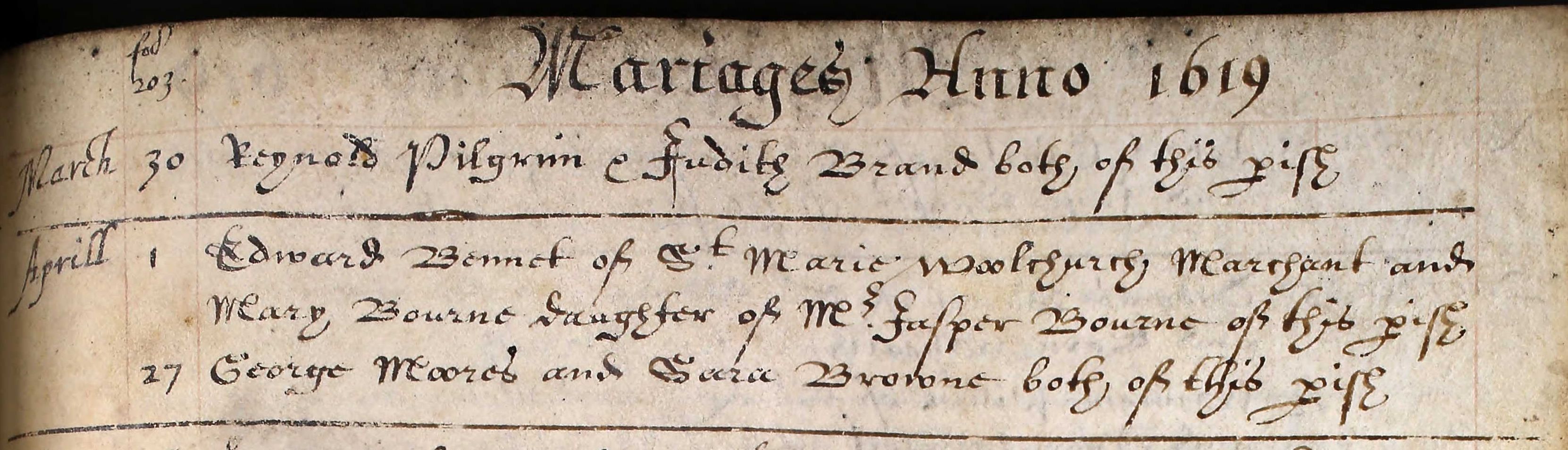
Of the following, Elizabeth, Ann, and Jasper died in childhood. Elizabeth Bennett and her grandfather, Jasper Bourne, are buried in the village of Stanmore, also known as Great Stanmore or Stanmore Magna, and now part of Greater London.
On 9 June 1623, Edward's brother, Robert, the first to go to Virginia, wrote a letter from "Bennetes Wellcome" to "Mr Edward Bennett, Merchant in Bartholomew Lane in London." But let's first look at the parish church of St Olave on Hart Street.
In the following table, Edward's children are represented in beige. Those in yellow belong to Thomas and Alice. I believe this is the son of Thomas and Agnes of Wiveliscombe, baptized in 1620. He was in the right place, of the right age, and he named most of his children appropriately to the family. I have found no will for him but one exists for his widow, Alice, as discussed below.
The light blue entries are those baptized children of another Edward and his wife Elizabeth, likely the son of Thomas and Alice baptized in 1660.
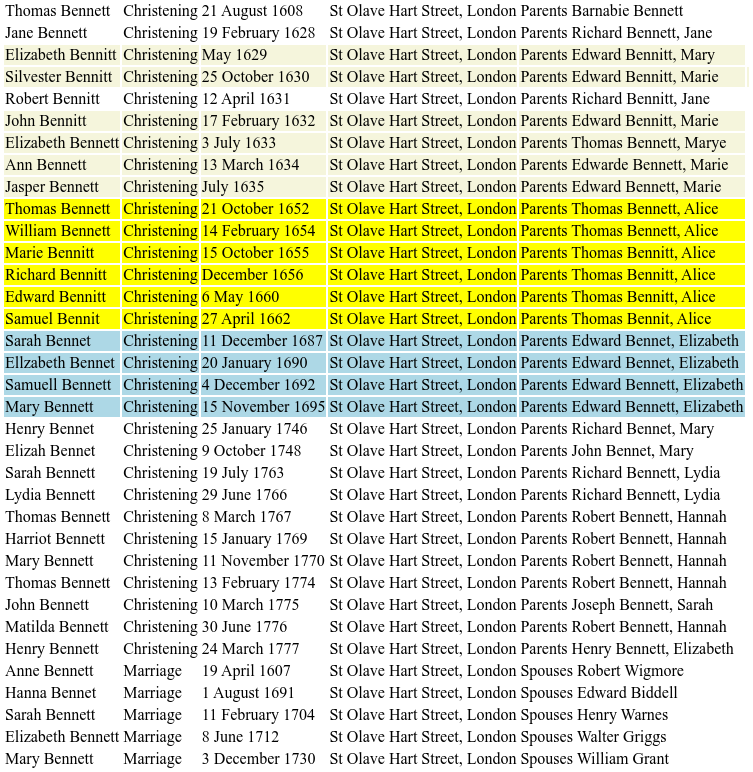
Most of my online research is done at Familysearch.org. Like all public trees, theirs is as bad as any. But they've transcribed tons of the millions of records the LDS Church has collected the world over. Nevertheless, it seems the burials for St Olave are missing. But no matter. We're not yet entirely an electronic world. The records were published in 1916. I find the following.9
The 1640 death might have been the son of Barnabie Bennett whose marriage is also recorded. Two sons of Thomas and Alice died young. And Thomas's widow, Alice, left a will, probated after her death in 1698. It states: "I Alice Bennett of the parish of St Olave Hart Street London widdow..." This, of course, puts her husband's death before that date. A 1695 city census of London, however, tells us that Thomas was still living as of that year.10 The will names her son Edward and her grandchildren Sarah, Elizabeth, Samuel, and Mary, just as shown for Edward and Elizabeth in the St Olave church records. I find no marriage for Samuel at St Olave, but the church recorded the for his three sisters.11
We have enough information to begin to construct a family for Thomas and Alice. It can serve as a template for further research.

The St Olave burials informs us that sons Thomas and Richard died young, Richard at about the age of 20. But we don't know about sons William and Samuel, except that they're not mentioned. Alice's grandson Samuell was an infant at her death. If he didn't survive to adulthood, then this line also went extinct, Y chromosomal-wise. I do have a half-baked theory, however, that he might have been the Samuel of St Margaret Lothbury, number 5 on the last map at the end of the article. If so, he christened several children there. But I'll leave it there for now and footnote it.12 As I said earlier, similarity of name and age alone are not enough. Still, Alice's granddaughter's marriages may be a good opportunity for others to hook into the Wiveliscombe lineage.
Our senior Edward Bennett (1577) attended at least four churches near the city center and lived in the neighborhood of St Mary's near Lothbury Street, although no record for him is found in that parish.13
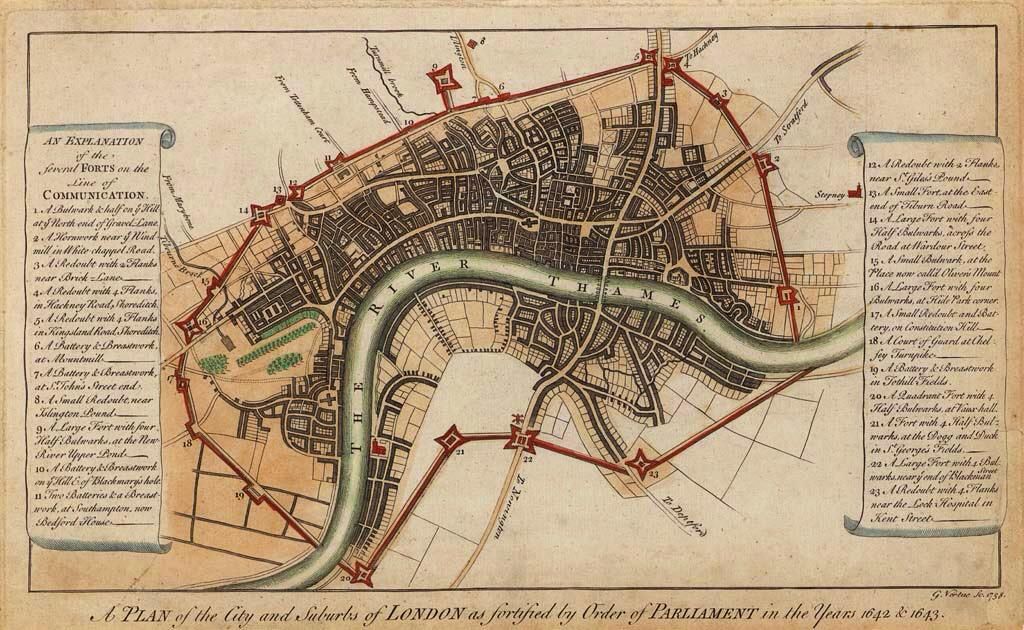
And here's what it looked like in 1642.
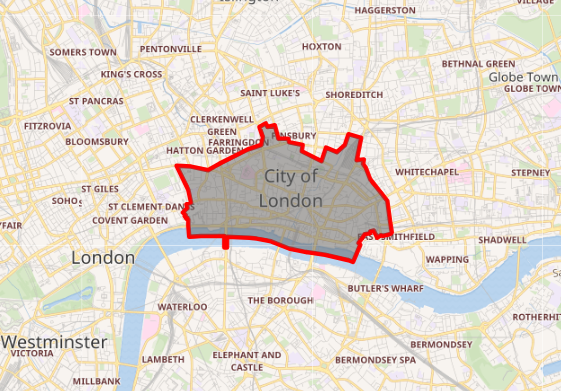
All these locations are in the southeast corner of the City of London, known by locals as the City. It is one of the 33 administrative districts of Greater London and comprises a little more than a square mile of Greater London's 1,856 square miles. Many American cities have an "Old Town" neighborhood. This is what the City is and essentially where it all began.
Edward lived in one of the world's greatest neighborhoods of the time — near the Tower of London, Shakespeare's Globe Theater, and at the very seat of the Kingdom of England. Stepney, which we often see in association with the Bennetts, is well outside the City of London. Like Stanmore, it was then a town of its own situated in the county of Middlesex, which has been almost entirely absorbed by Greater London. Bennett, it seems, lived in the southeast quarter. Considering that the whole area is only a square mile, he could have easily walked anywhere, including to all the churches he was known to have been associated with. For example, it would take about 15 minutes to walk from Hart Street to Lothbury Street.
I've created a modern map of Edward's neighborhood. Some of the streets he walked along have since disappeared and others have arisen. For example, the famous diarist Samuel Pepys wasn't born until 1633 and Pepys Street, right around the corner from St Olave, wasn't there at the time. (Pepys did attend St Olave so it's possible Thomas and Alice knew him.) And the map includes St Margaret Lothbury. Here we find the family of the aforementioned Samuell Bennett, perhaps of Edward's family, perhaps not.
The following markers mark these locations.
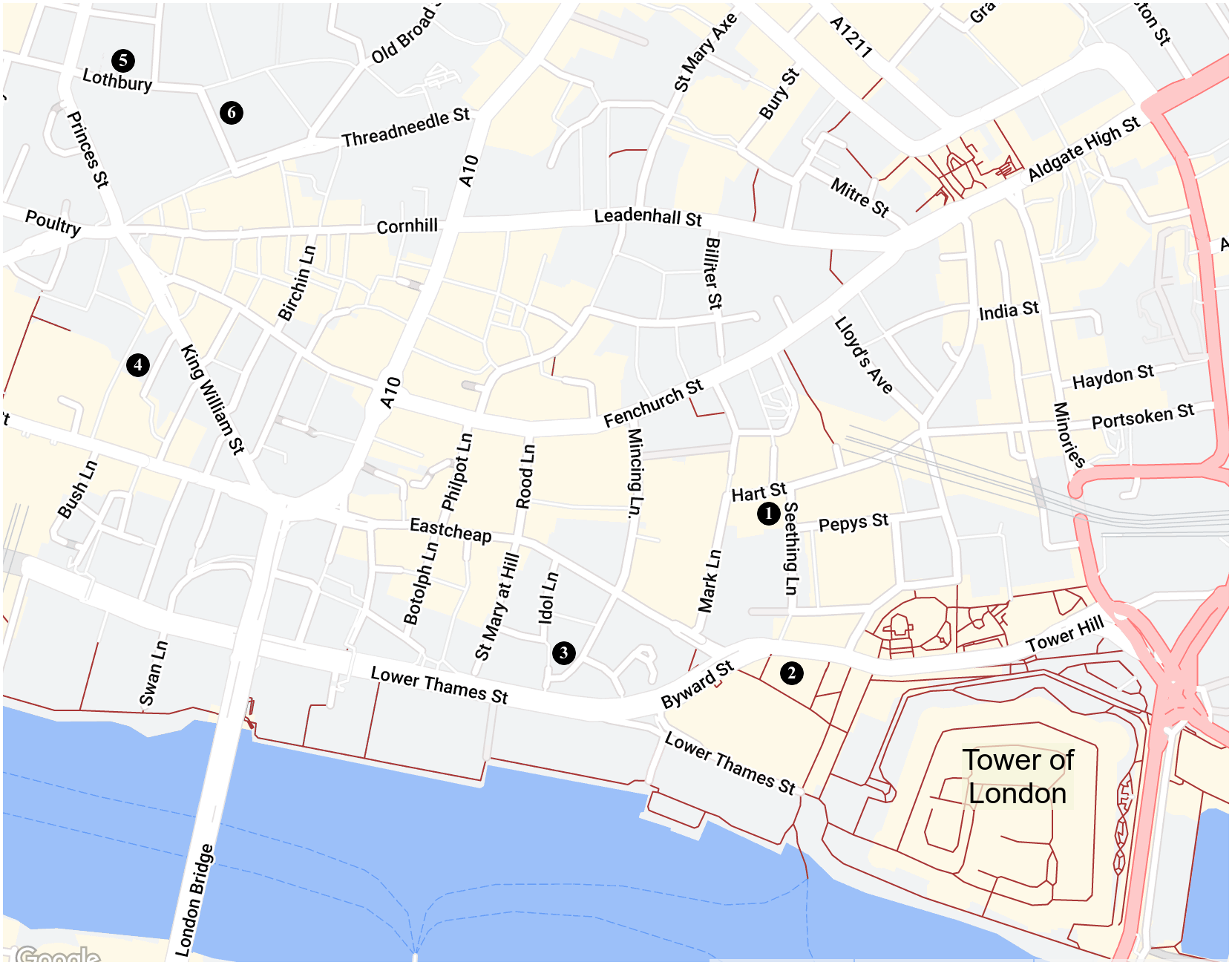
We can strengthen the claim that Edward likely lived the parish of St Mary Woolchurch Haw by citing that his brother, Richard Bennett and his wife Judith Brent had several children christened there, as listed by Archibald Bennett:14
Richard was the second of Edward's brothers to have crossed the Atlantic to manage Edward's estate. The following, recorded at the Prerogative Court of Canterbury, 1620-1630, proves his death, his relationship to Edward, and and his wife's name.15
Richard Benet, St. Bart. Exchange, London [St Bartholomew by the Exchange], but dec. in Virginia, administration granted to his bro. Edward Benet (his relict Judith Benet renouncing), 8 June, 1627.
Again, St Bart comes up.
Edward Bennett's death is still unknown, but we can possibly narrow the time frame. Edward and his brother John had both married into the prestigious Bourne family, Edward to Mary and John to Elizabeth. Their father-in-law, Jasper Bourne of Stanmore, signed his will in 1635. It was proved by his son-in-law John Bennett on 4 May 1636.16 But it seems John had left some matters unsettled. We find that on 3 June 1651 Edward Bennett's wife, Mary Bennett, was granted administration for that part of Jasper's estate left undistributed. John Bennett, then, was dead by that year. But it makes no mention of Edward's death, as numerous interpreters of this document had imagined. On 26 May 1659, Mary Bennett's estate had been conveyed to her daughter, Mary Bland. Mary Bennett, as explained in the document, was "later of Stanmore in the County of Middlesex, deceased."17
If living, Edward Bennett would have been 74 in 1651 and 83 in 1659. Either is possible but well beyond the life expectancy of the time. A deeper dive into the estate records is required. There is an intriguing will from Surrey County probated in 1650. He names sons John, Edward, and Thomas. The names and dates fit very well, but he also names wife Sarah and daughter Mary Gunner. This is certainly not the same man.18
And we mustn't forget Edward's brother, John. He was baptized eleven years earlier than Edward and also married into Jasper Bourne's family,. He must of been close to Bourne as John was named executor of his will. Bourne doesn't name his grandchildren through Edward, but he does name John's children, including sons Chester, of unknown dates, and John, christened in 1621. Neither man has been found. The parish in which John lived in unknown as is his death except that he was dead by 1651, discussed above. John may have been the same John Bennett who is recorded as being in Virginia in 1623.
I believe we can confidently say that the Robert Bennett who married Alice is of the Wiveliscombe Bennetts and a probable descendant of Edward. We have nothing that says so explicitly, but the evidence is strong: They attended the same church and, possibly, lived in the same parish, and the naming patterns are virtually identical. Finally, Alice was buried at St Olave, Hart Street.
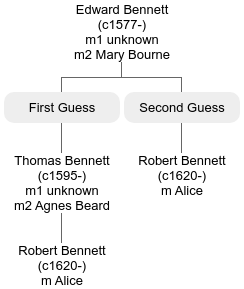
But Robert's parentage is still not established. As noted above, I see two possibilities, especially if we consider that Robert is of the Wiveliscombe Bennetts. He could have been an undocumented son of Edward Bennett and Mary Bourne or, perhaps, the son of Thomas Bennett and Agnes Beard and born in Wiveliscombe about 1620. In the latter scenario, we have another problem. And we still don't know to whom Agnes's Thomas was born.
We can't just pick and choose, of course. However, despite the lack of documentation, we do have a good alternative in the Y chromosome. It's difficult for me to imagine that of all the male progeny produced by the Wiveliscombe Bennetts that none are now living. Of course, extinctions happen. And there might well be extant NPE lineages hidden away in other surnames. Yet we can't prove anything genetically without first knowing the Bennett family's Y-DNA haplogroup, and that can't occur without a tightly-documented Bennett lineage. Nevertheless, if we manage to pull it off, a number of mysteries will be resolved, such as we've done between the Blackwater Bennetts and the descendants of "Doctor" John Bennett.
Once again I need to stress that much of this is a loose interpretation of established events as recorded in the Anglican church. And there are huge gaps in that record. A close scrutiny of non-church records may reveal more. But should we find a living male representative of this family we might acquire infallible evidence by means of his Y chromosome, a biological record that is traced back to the virtual beginning of the species and generally unaltered through natural selection.
1. The Y chromosome carries the male sex gene. By definition, then, women don't have a Y. Instead, they have two X chromosomes, neither of which will have the male sex gene. All men inherit it from their fathers and pass it to all their sons. Because the Y passes 100%, testing provides a genetic trail straight back through the paternal lineage. This pattern makes it an extraordinary tool for surname studies.
2. Martha W McCartney, Virginia Immigrants and Adventurers, 1607-1635: A Biographical Dictionary (Baltimore: Genealogical Publishing Co., 2007), 127. Richard Bennett, age 20, and his cousin Robert Bennett, age 18, first appear in Virginia records in 1628, as does their uncle Edward Bennett. We might assume they arrived on the same ship sometime that year. In a statement made at court at James City on 21 January 1628 regarding an issue with John Burland, Robert referred to Edward Bennett as his uncle. He was the son of Edward's brother William Bennett and his wife Alice Story. Robert was still living in Virginia in March 1648 when he was named a councilor.
3. John Frederick Dorman, C.G., F.A.S.G., Adventurers of Purse and Person, Virginia, 1607-1624/25 I, 4th ed. (Baltimore: Genealogical Publishing Co. Inc, 2004), 229.
4. Archibald F Bennett, "Bennett," The William and Mary College Quarterly Historical Magazine, Vol. 16, No. 2 (April 1936), 317.
5. Michael Cooley, "Anstice Thompson Alias Spicer of Milverton," dna.ancestraldata.com, 15 June 2023, web: https://dna.ancestraldata.com/groups/Bennett/Reports/Two_Thomases.html
6. Michael Cooley, "Thomas Bennetts Christened in England About 1587," dna.ancestraldata.com, web: https://dna.ancestraldata.com/groups/Bennett/Reports/Thomas-1587.html
7. Any genealogical claim needs documented evidence to demonstrate its truthfulness. For a further discussion, see Michael Cooley, "The Donkey Tail Method of Doing Genealogy," bogusgenealogy.com 31 January 2023, web: https://bogusgenealogy.com/viewer.pl?2023-01-20-donkeytail.html.
8. John Bennett Boddie, "History of the Bennetts," Seventeenth Century Isle of Wight County Virginia I (Chicago: Chicago Law Printing Company, 1938), 269.
9. W Bruce Bannerman, FSA, editor, The Registers of St Olave Church, Hart Street, London, 1563-1700 (London: Boworth and Company, 1916) web, https://archive.org/details/registersofstola46stol.
10. This entry, "Thos; Alice, w, 43.18," is found in London Record Society. "London Inhabitants within the Walls", London Inhabitants Within the Walls 1695, (London, 1966). British History Online, accessed July 2, 2024, https://www.british-history.ac.uk/london-record-soc/vol2.
11. "Will of Alice Bennett, Widow of Saint Olave Hart Street, City of London," Prerogative Court of Canterbury, probated 1 December 1698, reference PROB-11-448-289.
12. Children of Samuell and Mary Bennett baptized at St Margaret Lothbury: Littis Bennett, 1713; Joseph Bennet, 1715; Samuell Bennett, 1716; George Bennett, 1717; Jno Bennett, 1718-1718; Mary Bennett, 1719; Bridgett Bennett, 1720; Elizabeth Bennett, 1722; Catharine Bennett, 1723; Ellenor Bennet 1724. There's a 1740 will in London (PROB 11/700/374) for "Samuel Bennett Citizen and Merchant Taylor of London." He names son Joseph, brother Joseph, and daughters Mary, Elizabeth, and Eleanor. It's a close match to the family of Samuell of St Margaret Lothbury. However, Alice Bennett names no grandson named Joseph.
13. JMS Brooke, MA, FRGS, Rector of United Parishes, et al. The Transcription of the Registers of the United Parishes of St Mary Woolnoth and Mary Woolchurch Haw, in the City of London, 1538-1760 (London: Bowles & Sons, 1886), web; https://archive.org/details/cu31924029785478/page/32/mode/2up
14. Archibald F Bennett, 316.
15. J H Morrison, editor, Letters of administration, 1620-1630 (inclusive): abstracts, translated from the original Latin, arranged and numbered in alphabetical order of intestates, with separate indexes of "stray names" and places by Church of England, Province of Canterbury, Prerogative Court of Canterbury. (London, 1935).
16. "Will of Jasper Bourne, Gentleman of Great Stanmore, Middlesex," Prerogative Court of Canterbury, probated 4 May 1636, reference PROB 11/171/14.
17. John Frederick Dorman, C.G., F.A.S.G., Adventurers of Purse and Person, Virginia, 1607-1624/25 I, 4th ed. (Baltimore: Genealogical Publishing Co. Inc, 2004), 228-229.
18. "Edward Bennett of Godstone, Surrey," Prerogative Court of Canterbury, probated 21 September 1650, reference PROB-11-571-416.