Michael Cooley, BA, MA – 29 May 2022
I'm the administrator (or co-admin) for 20 DNA projects at FTDNA.com with 16 years experience at analyzing Y chromosomal results as an assist for genealogy, and with more than 350 Big Y interpretations under my belt. But first, to be clear, I'm not a for-profit kind of guy and don't work on behalf of any commercial entity. I'm retired, 72, and do this is my spare time, which amounts to nearly 24/7 — just 'cuz I enjoy it so much. Both my degrees come in handy — history and nonfiction writing — as do a variety of skills: academic-style research, web design, coding, teaching, and more than 45 years of genealogy experience. I blog about genetic genealogy and write about any number of subjects. I've helped project members find additional ancestors while providing the larger and deeper context. I've also busted several genealogical myths — and others are presently on their way — and I've used DNA to break through numerous brick walls — my lineages and those of others. This is what I do. But because I don't depend on income from this, I tend to stick with areas that are of some degree of personal interest to me. As shown below, I have a very big interest in the Bennetts.
The process of analyzing Y chromosomal results is really quite simple but often stalls if only for a lack of testers. That dearth of data causes long delays. Frankly, it can take years to sufficiently develop the data and evidence. And having only one tester per surname lineage is not enough. Genetic genealogy, like virtually all sciences in general, is about comparative analysis (true for doing genealogy itself). More than just one set of data is needed. Several sets are required to make adequate comparisons to derive even a minimal analysis. Think of it this way. Serious chromosomal research (chromosomes had been discovered not long before) started in 1902. A half century passed before the structure of DNA was uncovered, and that only through the rigors and tools of science, including comparative analysis. It took another 50 years before the majority of the mapping of the human genome was completed. About the same time, a little more than 29 years ago, the technology reached the public and genealogists jumped in. This is a slow moving train.
GOVERNOR RICHARD BENNETT
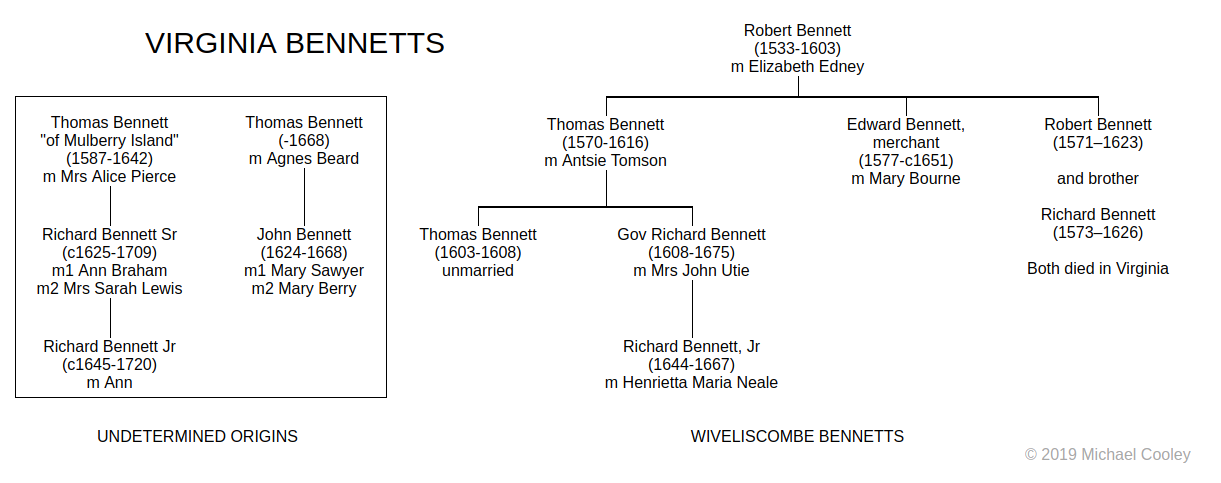
I'm a descendant of Richard Bennett (1608-1675), Cromwell's pick for the governorship of Virginia Colony for several years during the English Civil Wars. I'm not going to tell much of his story here, which is quite remarkable. Instead, for the purpose of this report, I'm interested only in his Y chromosome. But that pathway has run cold. The following short paragraphs should be enough to detail this particular genealogical problem.
Richard had only two daughters and one son, Richard Bennett Jr. Son Richard traveled to England, along with his infant daughter and pregnant wife, with him. He died a young man, either while traveling to or after arriving at his destination. I suspect the family's presence informs us that this wasn't merely a business trip nor a vacation among relatives in the family's hometown of Wiveliscombe. Instead, I believe, he was to make a permanent residence in order to represent his father's business interests. All for naught, it would seem.
Nothing is known about the details of Richard Jr's death other than the year. We know his only son, Richard Bennett III, was born in England shortly after the family's arrival, and that they stayed on for some years. And we know from the Governor's will that his grandson was attending school at Bristol in 1674, near the family's ancestral home.
Richard III (no, not that one!) and his sister returned to the colonies not long after their grandfather's death. The grandson lived a long life, inherited his grandfather's lands and interests, succeeded in business himself, and was the richest man in the colonies in his time. He married but had no children. His will is vast and lists a boatload of cousins, relatives, and friends. He died in 1749.
And that was the end of the governor's Y chromosome. But not all was lost. He had several brothers and uncles, all of whom carried an exact copy of the family's Y-DNA. They would have passed the Y chromosome down to their sons, and they to theirs. Although a fully-proven male descendant has not yet been found of these Wiveliscombe Bennetts, we do have one possible clue toward the collection of Y-DNA evidence. There were other Bennetts in Virginia of whom many researchers want to attach to the governor. Very likely, most of them were not related. But some, such as the Blackwater Bennetts, might have been.
Burial records prove that Richard Bennett's brother, Thomas Bennett, was born to Richard's father in 1603 and died five years later. The fact presently appears indisputable, but various researchers claim that the Thomas Bennett who married Agnes Beard was that same son. Indeed, the years given for him, 1603-1668, are found among the burial records for London. But Agnes and Thomas moved to the fledging Virginia Colony. It's certainly possible this man returned to London, but the 1603 date itself informs us the man who died in London could not have been a brother of the governor. Yes, it's possible Richard had a second brother named Thomas born after the first Thomas died in 1608, but no record for has been found for him nor was the Thomas who died in London, assuming the dates are correct. But that a Thomas and Agnes married in Somerset is telling and they might well have been born of the same family of Bennetts. However, a large number of Bennetts were present in the colony.
THE BLACKWATER BENNETTS AND Y-DNA TESTING
There was another Thomas Bennett (1587-1642) "of Mulberry Island" and "of Blackwater," but I've only recently learned that I had the Blackwater Bennetts assigned to the wrong Y-DNA tester — that was based solely on his word (bad idea). However, it turns out that several male descendants of the Blackwater Bennetts have done Y-DNA testing. Their Y-111 test results are a matter of public record.
This report (yes, I've barely begun!) largely involves their 111 Y-DNA STR markers, known to FTDNA as the Y-111. This is not the place to get into detail about STR markers, but I hope it will suffice to say for now that they regularly mutate in such a manner that makes them useful for only for clumping with like results. STRs help to distinguish between two and more DNA groups, even of the same surname. That's a huge advantage but runs short of the full story, for which I'm trained to relate. Still, Y-STRs are a great start. For example, mine informed me 16 years ago that I'm of the CF01 group of Cooleys, not CF07, not of CF02, or any other Cooleys. The CF01 Cooleys are vastly removed from the others and are not related at all through the fatherline. In other words, all the Blackwater Bennett testers are related to no other group of Bennetts. That's great news as they've narrowed their search to a remarkable degree.
These are the values for the seven men of the group who have tested for the Y-111. Here is a graphic that defines, to a degree, the relatedness among them. The numbers listed at the top of the column is the modal and represents the most common values among the testers for each column. The lines at bottom represent the smallest value found and the largest value. The number in blue next to the kit number is the genetic distance (GD) between the tester and the modal. (All of this changes with each new tester.)

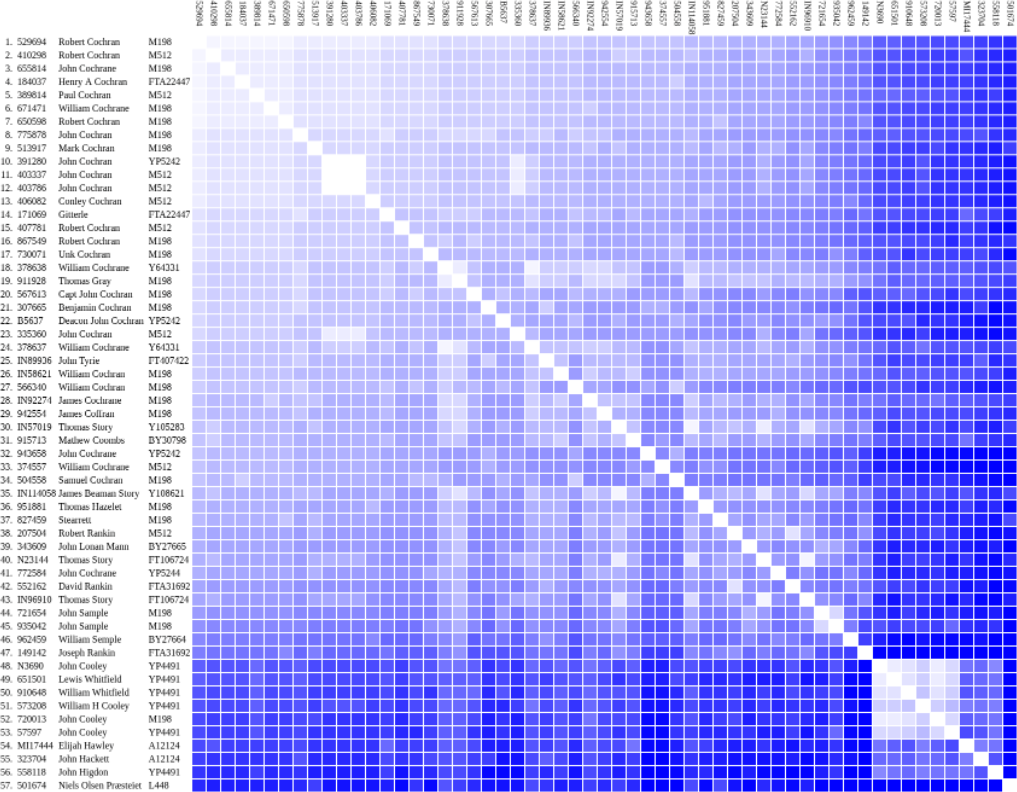
And following are the cluster analyses of the same results. The GD is determined between every tester and all others. For example, the GD for #112655 compared to his own test is 0. The second graphic simply has the values replaced with equivalent color values.

|  |
This particular graphic doesn't seem like much. After all, these testers come from the same most recent common ancestor (MRCA). But it gives some hint about the degree of relationship between them. Still, because of the nature of STRs it's not reliable. For example, this is the "Big Blue Box" of the R1a-YP4248 Project. Most of it makes sense, but much of it does not. Once a pattern starts, it fails. Thus is the fickleness of STRs. There is, however, testing that is vastly superior.
THE BLACKWATER BENNETTS AND THE BIG Y
The Y-111 is not the only test taken by the Blackwater Bennetts. Two have taken the test known as the Big Y aka the Y-700. It looks at up to 15 million positions on the Y chromosome and extract entirely different markers called SNPs. Again without getting into the details, unlike STRs these SNPs are not flaky and do not mutate back and forth between values. Once done, they're stable and pass down through lineage as long as the men in the lineage exist. Some SNPs, for example, are known to be over 300,000 years old. (If interested, I can explain how we know that.) Thousands are extracted, each one first born with a specific man at a specific time and place. Good luck, of course, in finding the identity of the man born 300,000 years ago! But the point here is that there are men still out there with those same markers first born of that man.
These SNP mutations occur on an average of once every four generations or so. Not so per every lineage, of course, but I need not explain the Law of Averages. However, new SNPs first see the light of day literally every day, and every man holds an archive of his SNP lineage in every cell. It's time to do some mining.
FTDNA kit numbers #535811 and #B842365 have done that test. Through comparing their results with more than 200,000 test results from FTDNA's database, it's been determined that their known most recent SNP marker is R1b-BY172987. There's more to it than that, though. I have not yet seen those results and will certainly run reports on them once I do. Even then, there will be data in that report that will require further research. Nothing is done until it's done.
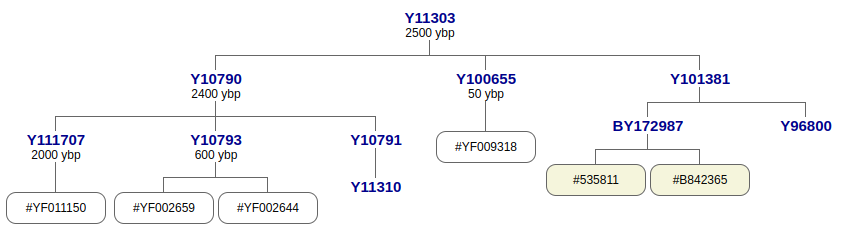
Here's a tree I created that combines data from both FTDNA and Yfull.com to show the larger context for the Blackwater Bennetts. It goes back 2500 years, long before surnames were used in Europe and Britain in particular. The vast majority of it is not relevant to the genealogical time frame, but I am interested in the tester in group Y100655. I do not yet have the information needed to date your group.
And we can go back even further. First understand that autosomal testing is generally good for only about five to seven generations. The Big Y overlaps or otherwise picks up from there and leads us back hundreds, even thousands, of generations. Again, this kind of depth is impractical for day-to-day genealogy. But it's of great use to population genetics, geographers, and archaeologists, all of whom benefit from these tests. A single graphic, for example, will follow your SNP trail all the way back to Africa with notations for virtually every stop your direct male ancestors made over more than 60,000 or more years. This journey, like the DNA, that was passed from one father to all his sons, to all their sons right up to the present day. The whole shebang is archived on the Y chromosome. It just needs analysis and interpretation. Here's the journey that brought your Bennetts to town.

If we wholly trust this map, your Bennetts were present in Britain during the Roman era. But this image results from a statistical analysis and will vary once more data arrives. But it's a great start.
GOVERNOR BENNETT REDUX AND BEYOND
Richard's uncle, Edward Bennett, may have been the reason for the future governor's success. He established a plantation in the colony in 1621, sending his brother Robert to manage it. Robert died two years later and Edward sent brother Richard to replace him. After Richard died, the man himself traveled to Virginia in 1628 accompanied by his young nephew, the future governor, Richard, barely 20 years old. After a year, Edward handed over the management of the plantation to him and returned to England where he died some years later. He had an extensive family, but their lineages have yet to be established to the present day. So far, neither a will or other probate has been uncovered for him. We only find mention of the deceased man in a 1651 document, indicating that he was dead by that year.
There were a number of Bennett families in Somerset during this period, many of whom were likely not related to one another. And if we accept everything that has been written on the subject, all the Bennetts in Virginia were related to the governor. However, there is zero historic and genealogical evidence to support that conjecture, the reasonably good work of John Bennett Boddie notwithstanding. But we can learn more about this through Y-DNA interpretation.
But finding how the Virginia Bennetts were related among one another and to the governor is only one part of the puzzle. Researchers try to make Richard a descendant of the Pythouse Benetts of Wiltshire and of the Clapcot, Berkshire Bennets; indeed of virtually any Bennett family of note in England they can find. However, there is no historic or genealogical evidence to back it up. These myths are so off-the-wall that Richard's grandfather is frequently redefined as the Earl of Tankerville. In fact, Robert Bennett (c1533-1603) was a small town tanner. Furthermore, the Bennet creation of the earldom didn't occur until 1714, six decades after Richard's own death. (The first earldom of Tankerville was held by the Grey family and forfeited in 1459.)
So, my proposal is this: expand the current Blackwater Y-DNA tree, find the haplogroups for other Virginia Bennetts, look for living male descendants of the Somerset Bennetts and those of the Pythouse Benetts and the Berkshire Bennets. In fact, the DNA for the latter can be found in the cells of Peter Grey Bennet, 10th Earl of Tankerville (b 1956). But good luck into sweet-talking him into testing!
My 16 years of experience and countless forays in Y-DNA analysis instructs me that we can do this. The only reason it takes so darned long is that it's difficult to find testers. Some turn away simply because they don't understand it. I get that but, you know, that's my job. I understand this forward and backward. And who knows, perhaps in the end we'll get an academic paper published.
I'm always happy to answer questions about any of this. Please feel free to contact me, Michael Cooley, BA, MA. And I've just started a group at Facebook for us, Somersetshire Bennetts. Three similar groups I manage are quite successful.
